






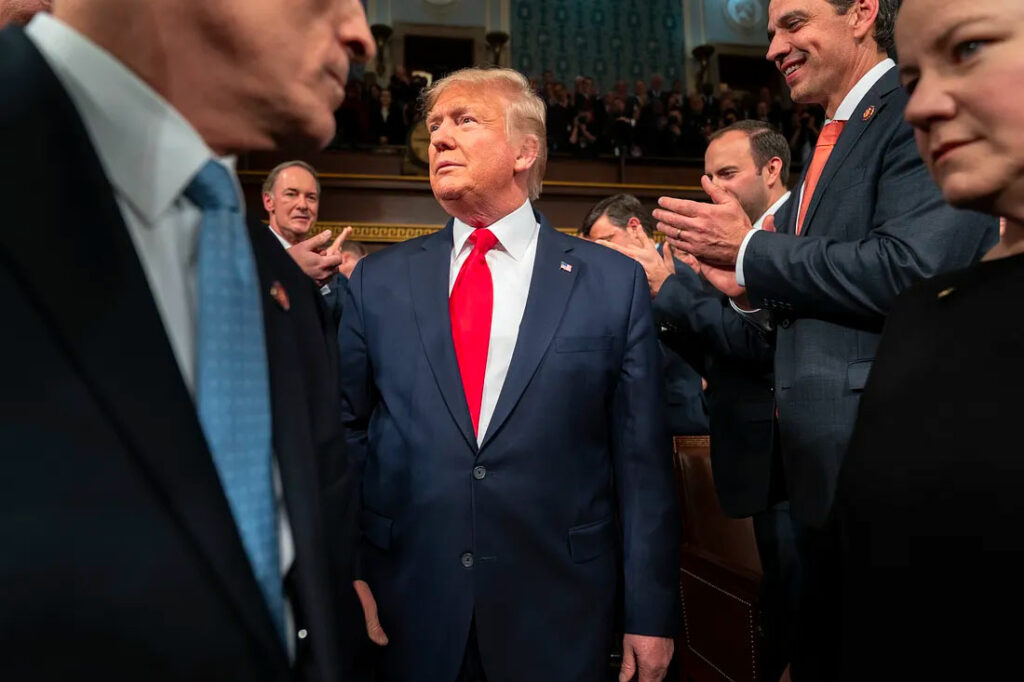








Generative AI is common to the vast public and seems to be making its way into the White House. President Donald Trump is no stranger to generative AI, which is artificial intelligence that is able to create original content. On Saturday, Oct. 18, President Trump posted an AI video on his Truth Social X account, where he was pictured wearing a crown and flying in a jet labeled “King Trump”. Protesters all around the country had gathered prior in a “No Kings” rally against Trump earlier that day, resulting in his post.
Trump has also been under fire due to the White House’s recent posts and reposts from the White House, which many deem as unprofessional and immature. For example, just a week after the pope died, Trump posted an AI image of himself as the pope, and the White House reposted it.
A commenter wrote, “I never thought I’d see the day when the White House is just a joke. This is so embarrassing,” a commenter wrote on X.
However, many social media users from the emerging generation don’t see an issue, believing Trump is simply finding a way to appeal to the younger audience.
When asked for a statement about it,White House spokeswoman Abigail Jackson responded shortly in an email, writing, “Who cares?”. Some Dunbar students agree, while others believe the situation is not being taken seriously enough.
“You can clearly tell those photos are AI, so it’s not that big of a deal,” Sophomore Aya Hadi said.
“It’s not okay for a president to position themself as a god-like figure. Religion historically has been used by leaders to justify any and all actions, and such sentiments are a dangerous infringement upon democracy,” senior Wilson Owen said.
Others worry about the older generation and the lack of awareness in their community.
“The older generation can’t always distinguish what’s AI from what’s real. I wouldn’t be surprised if someone really believed that Trump is the new pope. He’s crossing the line with this misinformation,” Junior Harrison Pope said.
From an educational standpoint, students in classrooms all over the country have turned to AI to eliminate doing basic academic tasks. For anything from homework to essays, they simply run to AI.
“It starts to become a problem when AI is answering the questions for you,” Biology teacher Mr. James Whitfield said. “What you’re losing is the chance to think about the question. You won’t understand how to be a good thinker.”
The sentiment is shared by students as well, some of which worry about their fellow classmates’ reliance on AI.
However, AI is not all negative. There are numerous beneficial ways to utilize AI in education. Teachers at Dunbar may even encourage the limited use of AI for certain assignments or projects, or to help study for tests.
Mr. Whitfield added, “But using AI to study seems like a wonderful tool. It’s to be an aid for you. That’s the perfect use.”
If students use AI to learn or study rather than to simply get the answers, they may be able to increase test scores. One student comments on her use of AI for studying.
“I use ChatGPT to help study for tests. It’s much more efficient than spending time making flashcards,” said Freshman Emerson Easley.
Whether AI is being used in classrooms or politics, it’s definitely making an impact.
