















For years, Dunbar has faced a continuous problem with its roofing that now affects students on a daily basis. The roof in 1991 when the building opened and has never been replaced, despite decades of wear and mounting damage.
Dunbar’s roof is completely flat and is composed primarily of Spray Polyurethane Foam (SPF), a material that is designed to expand into an airtight seal. SPF is commonly used for its insulating properties, resistance to severe weather, and longevity relative to traditional systems. While SPF can last for decades under ideal conditions. While SPF can last for decades under ideal conditions, its durability at Dunbar is subpar.
Over the past four years, the roof’s condition has rapidly declined due to damage caused by crows. The birds have pecked at the foam for nestling material and food, creating hundreds of holes across the surface. Despite several attempts to deter the birds, the damage has continued to spread.
According to Chief Operating Officer Myron Thompson, these openings have caused widespread leaks throughout the building. Ceiling leaks have become regular occurrences, with ceiling tiles collapsing in hallways and classrooms. Students are often forced to detour around unsafe areas or relocate to different rooms or areas entirely.
The consequences extend beyond inconvenience. A senior, Rubi Diaz, described an incident that alarmed her.
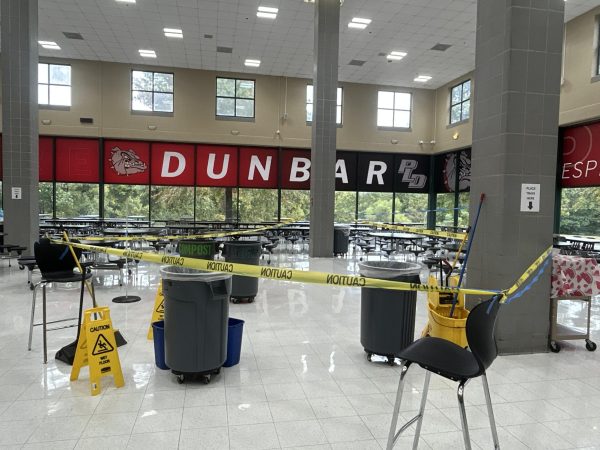
“I watched the ceiling tile fall in real time in the cafeteria,” she said.
In other classrooms, moisture has led to pest infestations.
“There’s ants falling on our heads.”Jackie Durand said.
Jackie further said the pest infestations are a distraction, something that she always expects but still causes discomfort.
Custodial staff respond daily by placing buckets, bins, and tarps beneath leaks in an effort to limit damage. Despite these temporary measures, the problem continues to disrupt daily activities across multiple areas of the school.
The most severely affected program is the theatre department. Water leaks have flooded the theatre’s technical booth, damaging expensive equipment, including the soundboard and lighting control computer, according to theatre teacher Mrs. Alicia Henning. In 2022, student Alfred Haase reported that leaks had caused stage lighting to short out, creating safety hazards during instruction.
Mrs. Henning went on to share how, during one class period, students spent nearly a third of class time setting up protective covering instead of rehearsing. In the previous school year, a single storm resulted in 23 separate leaks in the theatre alone.
FCPS has deemed the roof replacement a priority and scheduled it for 2026; however, Thompson explained that uncertainty remains due to the district’s current budget. Many FCPS employees have also expressed doubt that the renovations will occur because of ongoing financial difficulties. This leaves one question: how many more leaks?